 Perspective shaped by experience
Business & Finance · 22 September 2026
Kylian Mbappé Leaves Nike for On: From Endorsement to Ownership
Mbappé’s move from Nike to On—and reports that the deal includes equity—shows how elite athletes are moving from endorsement towards ownership and influence.
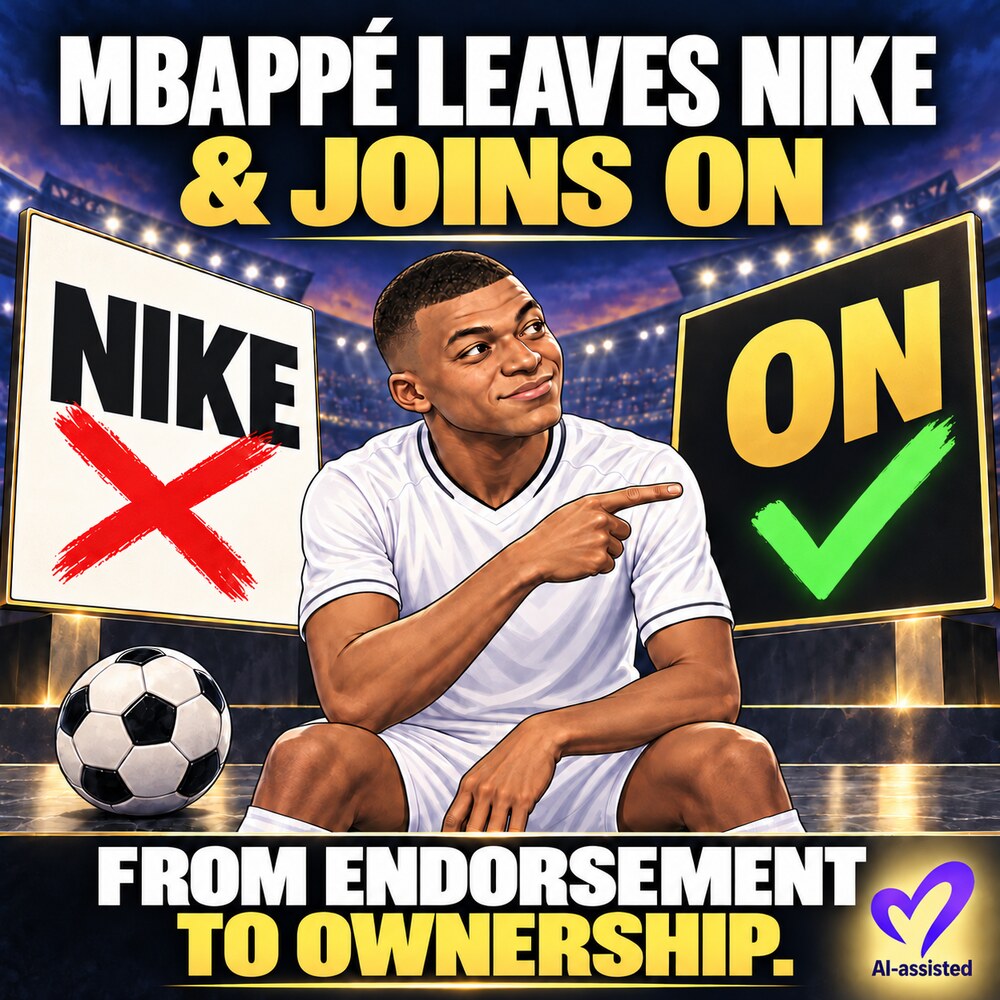
After nearly 20 years with Nike, Kylian Mbappé is joining On—the Swiss sportswear company associated with Roger Federer. But this appears to be more than a change of logo.
Reports indicate that Mbappé’s agreement includes cash, equity and the opportunity to contribute ideas as On expands into football. At Nike, he was a highly paid ambassador among many global stars. At On, he could become a defining face of the brand, with greater influence and a share in the value he helps create.
There is no confirmed quarrel with Nike; his contract simply ended. The more interesting story is the business logic behind the move.
Three lessons stand out:
- Fees reward today; ownership can participate in tomorrow.
- Loyalty is valuable, but it should not become inertia.
- A challenger may offer more influence than an established giant.
Equity carries risk, of course. On must keep growing for Mbappé’s stake to become truly valuable. Yet he appears to have chosen the possibility of long-term wealth over remaining merely an ambassador.
Sometimes the smartest move is not negotiating a bigger cheque—it is securing a share of the future.
Would you choose Nike’s security or ownership in On?
The bigger story behind the short story
The social-media version above captures the central business idea, but the deal deserves a closer look. Mbappé is not simply exchanging one boot supplier for another. He is joining a younger company at the moment it is entering football, and that changes the balance of the relationship.
Who are Mbappé and Federer?
For readers who do not closely follow sport, Kylian Mbappé is a French footballer who plays as a forward for Real Madrid and captains the French national team. He helped France win the 2018 FIFA World Cup and has become one of the most recognisable athletes of his generation. His speed, goalscoring record and international profile make his choice of footwear commercially important far beyond France or Spain.
Roger Federer is a retired Swiss tennis player and one of the sport’s best-known champions. He won 20 Grand Slam singles titles during a career noted not only for sporting success but also for unusually strong global appeal. After a long relationship with Nike, Federer invested in On and helped the Swiss company develop tennis and lifestyle products. His involvement demonstrated how an athlete could contribute capital, expertise and reputation rather than serving only as an advertising face.
Their sports are different, but the commercial comparison is relevant. Federer helped On move from running into tennis; Mbappé is now expected to help it enter football, a substantially larger but more competitive global market.
On announced the partnership on 18 September 2026 as the beginning of its move into football. Its official statement says Mbappé will be a global ambassador and will work directly with product teams to develop and test future footwear and apparel. Thierry Henry, who has been involved with On since late 2025, is serving as its Director of Football. The company has also brought in Swiss international Sydney Schertenleib as it develops the women’s side of its football plans.
The official announcement does not disclose the financial terms. However, Reuters reported that the agreement includes both cash and equity, while other reporting has described it as a long-term partnership. That distinction matters. Cash pays an athlete for the use of his profile today; equity may allow him to benefit from the value created tomorrow. It also introduces risk: shares can rise or fall, and a challenger entering a new category has much to prove.
Why leaving Nike is significant
Mbappé’s association with Nike began when he was a child. By the time he became one of football’s defining players, Nike had built major campaigns around him and produced signature editions of its Mercurial boots. The relationship linked the world’s largest sportswear company with a player whose speed, confidence and global appeal fitted the brand naturally.
There has been no confirmed public dispute. Nike said it was proud of the long relationship and wished him well. That is important because a change of sponsor is often described as though one party must have lost an argument. Contracts end, priorities change and both sides can make rational decisions.
Nike offers reach, established football credibility and a marketing machine few companies can match. It already works with many leading players, clubs and national teams. That strength can also create a different problem for an individual athlete: even a superstar is one prominent name within a very large portfolio.
At On, Mbappé enters as the central figure in a new football project. He can help shape products, the story and perhaps the culture of the category from its beginning. The move appears to exchange some of the certainty of an established platform for greater influence inside a challenger.
What On is trying to build
On was founded in Switzerland in 2010 and built its reputation in running. Its CloudTec cushioning gave the company a recognisable product idea, while its clean visual identity and premium positioning helped it extend into lifestyle footwear. It now sells in more than 90 countries.
The company has also shown a willingness to use athletes as more than advertising faces. Roger Federer became an investor and product partner, contributing to tennis and lifestyle products. That relationship gave On credibility beyond running and offered a model for combining athlete insight, profile and long-term commercial alignment.
Football is a much larger and more crowded test. Nike, Adidas and Puma have decades of product expertise, established supply relationships and enormous networks of players, clubs and federations. A strong running shoe does not automatically produce an elite football boot. The demands are different: traction, touch, stability, fit, weight, durability and adaptation to different pitches all matter.
On says it intends to apply its engineering approach to the sport. One technology it highlights is LightSpray, a robotic manufacturing process that sprays a continuous filament to form an upper. Whether that can create a genuine advantage in football will depend on the final product, not the presentation. Mbappé’s involvement in testing could therefore be more valuable than a conventional photoshoot.
Reports indicate that the first On football boots are planned for 2027, with apparel and lifestyle products expected to follow. That timetable suggests this is a product-development programme as well as a marketing launch.
Endorsement, partnership and ownership
Traditional endorsement is straightforward. A company pays for visibility, association and agreed appearances; the athlete receives a fee and often performance bonuses or royalties. The brand usually owns the product platform and most of the long-term commercial value.
An equity component changes the incentives. If On’s football business succeeds and strengthens the wider company, Mbappé may participate as an owner rather than only as a paid promoter. His profile attracts attention, but his product feedback and credibility may also reduce some of the risk of entering the category.
The word “ownership” should still be used carefully. The size, conditions and voting rights of any reported stake have not been publicly disclosed. It would be wrong to assume that Mbappé controls the company or that the equity is guaranteed to become valuable. The more accurate point is that his compensation reportedly includes exposure to the business value he may help create.
This reflects a broader change in the economics of celebrity. Athletes, entertainers and creators increasingly ask whether they should be paid only for attention or should also share in the enterprise built with that attention. For a company, equity can conserve cash and encourage long-term commitment. For the individual, it can produce greater upside—but with less certainty.
What happened in comparable athlete deals?
Mbappé is not the first athlete to exchange the simplicity of a conventional endorsement for a deeper commercial relationship. The results of earlier deals range from exceptional success to sharp losses. They also show that “ownership” can mean very different things: company shares, a royalty, a jointly developed brand or a mixture of cash and equity.
Roger Federer and On: the clearest success
The most relevant precedent is already inside On. Roger Federer became an investor and product partner in 2019, after ending his long relationship with Nike. He did not merely appear in advertisements: he worked with On on tennis footwear and the Roger product line.
When On floated in New York in 2021, the company was valued at more than $11 billion on its first day of trading. Reuters reported that the shares priced above their expected range. The exact size and cost of Federer’s investment were not officially disclosed, so widely quoted estimates of his personal gain should be treated cautiously. Nevertheless, the combination of rapid company growth, a successful flotation and an enduring product partnership makes this a strong example of athlete ownership creating value for both parties.
Federer’s success is also the template On appears to be adapting for Mbappé. The important difference is that On already had a successful running business when Federer joined; in football, the company is entering a new and highly competitive category.
Michael Jordan and Nike: not equity, but the benchmark
Michael Jordan’s Nike arrangement was not principally an ownership stake in Nike. It was a signature brand and royalty relationship. That distinction matters, but the economics illustrate the value of participating in sales rather than receiving only a fixed endorsement fee.
Air Jordan grew from a shoe partnership into Jordan Brand, a major business within Nike. Nike reported approximately $7.0 billion of Jordan Brand revenue in its 2026 financial year. It remains the standard against which athlete-led sports brands are measured.
The lesson is that ownership of company shares is not the only route to long-term participation. Royalties, intellectual-property rights and control over a sub-brand can be equally important. For Mbappé, the strongest outcome may eventually depend not only on the value of his On shares but also on whether he develops a distinctive product identity that consumers continue to buy.
Stephen Curry and Under Armour: commercially important, but mixed
Stephen Curry joined Under Armour in 2013 and helped give the company credibility in basketball. Curry Brand was launched inside Under Armour in 2020, and the relationship later included a long-term agreement with an equity component.
It was influential, but it never achieved the cultural reach or commercial scale of Jordan Brand. In November 2025, Reuters reported that Curry and Under Armour had agreed to separate, with Curry Brand becoming independent. That does not make the entire partnership a failure: it lasted more than a decade, sold products and helped establish both parties in basketball. But the eventual split shows that a famous athlete, equity incentives and a signature brand do not guarantee permanent strategic alignment.
For On, this is an especially useful warning. Mbappé can create attention and authenticity, but the company still needs competitive products, distribution, marketing discipline and agreement over the long-term direction of its football business.
David Beckham and Guild Esports: the downside of equity
A more sobering example comes from outside footwear. David Beckham became an investor and ambassador for Guild Esports when it entered the public market in 2020. The association generated visibility, but the underlying business struggled. By 2024, The Times reported that Guild had lost about 98% of its stock-market value and was fighting for survival.
This case is not directly comparable with On, which is an established international sportswear company with substantial sales. It does, however, demonstrate the central financial truth: celebrity can attract investors and customers, but it cannot repair a weak business model. Equity rewards success only when the company itself creates durable value.
The record is therefore mixed
Federer and Jordan demonstrate the extraordinary upside possible when athlete credibility, strong products and capable management reinforce one another. Curry shows that a partnership may achieve meaningful results yet still fall short of becoming the next Jordan. Beckham’s Guild investment shows that a famous name offers no protection when the underlying economics fail.
Mbappé’s arrangement should therefore be judged over years, not by the publicity surrounding its announcement. Early measures will include the quality of On’s first football boots, adoption by other players and retailers, and whether consumers associate the products with innovation rather than celebrity alone. The ultimate test will be whether football becomes a profitable, durable part of On’s business.
Why Mbappé is unusually valuable to a challenger
Mbappé brings several assets at once. He is an elite performer, captain of France and a global personality with particular appeal to younger audiences. His playing style—explosive acceleration, direct movement and decisive finishing—also gives a footwear company an obvious technical and visual story.
He is valuable in France and Europe, but his recognition extends much further. Football audiences follow players across club and national competitions, and social media allows a single athlete to introduce a new product worldwide. That makes him unusually capable of helping a brand enter a category where it lacks heritage.
There is also strategic clarity in using one dominant figure. A challenger cannot immediately match the number of contracts held by the established brands. It can instead concentrate resources around a small group of credible partners and build a distinct identity. The risk is equally concentrated: if the product disappoints, supply is limited or the partnership loses momentum, the weakness will be highly visible.
The deal through a finance lens
From a finance perspective, Mbappé appears to be accepting a different mix of return and risk.
Cash is certain value. A guaranteed endorsement payment can be measured and received according to contract. Its value does not depend on the sponsor’s share price or success in football.
Equity is contingent value. It may appreciate substantially if On grows, but it can also decline. The result depends on company performance, market valuation, the terms of the award and any restrictions on selling the shares.
Influence has strategic value. Product input, creative participation and a central position in the brand may increase Mbappé’s impact beyond the formal value of the contract. Influence can also strengthen his own commercial identity after his playing career.
Concentration cuts both ways. Being one of many stars at Nike reduces dependence on any individual relationship. Becoming the face of On football gives Mbappé greater prominence, but it ties more of the partnership’s reputation to the success of a new venture.
The best comparison is therefore not simply “Which company pays more?” It is “Which package offers the most attractive combination of guaranteed income, long-term upside, influence and risk?” Without the full contracts, outsiders cannot calculate the answer. We can, however, understand why a player with substantial existing earnings might prefer greater upside and participation.
What the move means for Nike
Losing a player of Mbappé’s stature is significant, particularly because he has been associated with Nike for so long. It gives a smaller competitor immediate credibility and creates a powerful narrative about moving from endorsement to partnership.
Yet Nike remains a giant in football. Its distribution, product range, athlete roster and club relationships cannot be replicated quickly. The loss of one athlete does not overturn that structure. Nike may also have reached a different view of the price, control or commitment justified by the relationship.
In negotiation, walking away can be rational for both sides. The buyer may believe the required package is too costly; the seller may believe another partner offers more than money. A deal is not evidence that one side understood value and the other did not. It is evidence that they valued the available choices differently.
What success would look like for On
Public attention is already a win, but lasting success will require more than launch publicity.
First, On must produce a boot that elite players trust. Footballers are sensitive to fit and feel, and a product failure at the highest level can damage credibility quickly. Second, it must make the product available at sufficient scale. Interest that cannot be converted into a purchase is a missed opportunity. Third, it needs a wider football ecosystem: additional athletes, youth adoption, retailer support and eventually credible apparel or team relationships.
It must also protect what made the brand distinctive. Chasing a mass market can dilute premium positioning, while remaining too exclusive can limit adoption in a sport whose culture is built on broad participation. The balance between aspiration and accessibility will matter.
A wider lesson for professionals
Most people will never negotiate a global sportswear contract, but the underlying choice is familiar. A large organisation may offer security, resources and prestige. A smaller organisation may offer responsibility, visibility and a closer connection between personal effort and future value.
Neither is automatically better. The right choice depends on financial resilience, appetite for risk, confidence in the people and product, and the ability to influence the outcome. Equity should never be treated as cash, and a fashionable promise of “ownership” should be examined carefully. Terms, dilution, liquidity, tax and governance all matter.
The strongest lesson is to evaluate the whole package. Salary or fees are important, but so are learning, authority, reputation, optionality and participation in future value. Loyalty deserves respect, yet it should not prevent a clear-eyed review when circumstances change.
The verdict
Mbappé’s move is compelling because it brings together sport, brand strategy and finance. Nike offered the power of an established leader. On offers the possibility of helping create something new. If reports about equity are correct, Mbappé is placing part of his compensation behind that possibility.
The deal may succeed brilliantly, or the established brands may prove too difficult to dislodge. On still has to design excellent products, manufacture them reliably and earn the trust of players at every level. Mbappé’s name can open the door; it cannot do all the work after that.
For now, the move illustrates a meaningful shift in athlete economics. The most valuable person in a campaign may no longer be satisfied with a fee for appearing in it. He may want a voice in the product and a stake in the outcome.