 Business · Management · Systems
Business Analysis & Strategy · Last updated: 13 November 2026
Should Your Budget Be Based on Your Ambitious Sales Target?
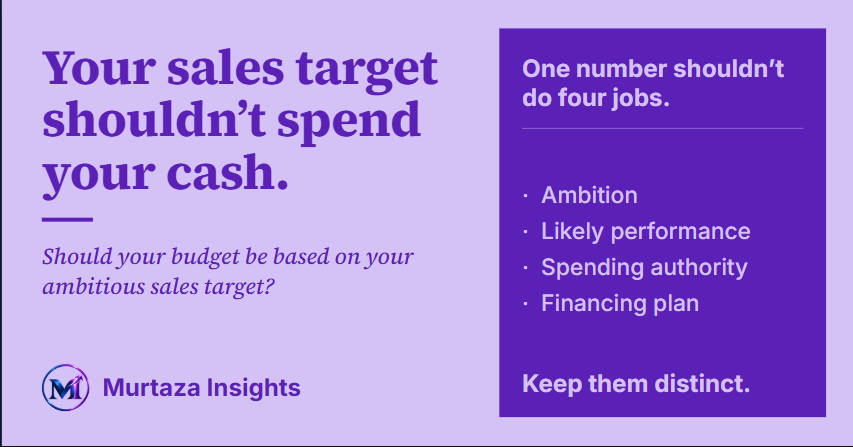
Keep ambitious sales targets without automatically committing the spending needed to achieve them.
In this article
At a Glance
A company approves an ambitious sales budget, along with the extra marketing, distribution and other spending needed to reach it. Six months in, sales are falling short, but most of the money has already been spent or committed.
Should the company have kept a realistic financial budget separate from the stretch target?
It is a useful question to consider while next year’s budget is being prepared. This article examines two alternatives and the circumstances in which a single ambitious budget may still be appropriate.
Where I First Met This Problem
At E.A. Match, we had no electronic spreadsheets until Lotus 1-2-3 became available to us in the late 1980s. Producing one budget was effort enough, and a second one wasn’t a luxury we had.
At Pwani Oil Products, we deliberately adopted ambitious sales targets. The thinking was that a stretch target would put pressure on management to push harder to achieve it. That approach reflected a management philosophy: setting higher expectations was intended to encourage greater effort and stronger performance.
The difficulty arises on the spending side. Campaigns, additional salespeople and inventory may be committed before the expected sales arrive. If those sales fall short, some of the expenditure cannot easily be reversed.
What has changed is the technology. With Oracle ERP subsequently installed at Pwani, maintaining more than one budget version may now be practical, depending on the system’s planning capabilities and configuration.
So the question is worth reopening.
Why the Target Usually Becomes the Budget
Annual budgeting starts with expected sales. Production, purchasing, staffing, marketing, working capital and financing are then built around that number. When management adopts a stretch target, the financial budget often carries both the ambitious revenue and the spending needed to achieve it.
There are good reasons for this. Departments work to one integrated plan, management sees its financial consequences, and results are measured against an approved benchmark.
The difficulty arises when the additional sales are uncertain but the expenditure required to pursue them is substantial. Owners and management then need to decide how much spending is justified by realistic expectations and how much depends on achieving the stretch.
An Illustration
Consider a manufacturer preparing its annual plan. All figures are illustrative.
| Sales planning measure | KSh million |
|---|---|
| Realistic Base sales expectation | 540 |
| Additional growth ambition | 60 |
| Strategic sales target | 600 |
Management believes KSh 540 million is realistic, given existing customers, demand, pricing, capacity and market conditions. It aims for KSh 600 million through more marketing, wider distribution and customer development.
The conventional approach puts KSh 600 million into one budget, together with the expenditure needed to pursue it.
Two alternatives deserve consideration.
Option A: A Base Budget Plus a Separate Growth Programme
This suits growth expected from identifiable initiatives, such as a new product, geographical expansion, additional distributors or a new sales channel.
The Base Financial Budget is a complete plan built on realistic sales expectations. A separate Strategic Growth Programme aims to generate the additional KSh 60 million.
The programme identifies the initiatives, expected contribution, additional costs and investment, accountable managers, milestones, working-capital requirements and financing needs.
Suppose it requires KSh 8 million of additional marketing. Owners and management can approve the overall programme while separating immediate commitments from expenditure that can be delayed.
| Expenditure | KSh million | Treatment |
|---|---|---|
| Initial phase | 3 | Approved for immediate commitment |
| Second phase | 3 | Released when agreed milestones are met |
| Further expansion | 2 | Requires fresh commercial justification |
| Total | 8 | Not all unconditionally authorised |
- Expenditure
- Initial phase
- KSh million
- 3
- Treatment
- Approved for immediate commitment
- Expenditure
- Second phase
- KSh million
- 3
- Treatment
- Released when agreed milestones are met
- Expenditure
- Further expansion
- KSh million
- 2
- Treatment
- Requires fresh commercial justification
- Expenditure
- Total
- KSh million
- 8
- Treatment
- Not all unconditionally authorised
Some costs must be incurred before revenue can be generated. Others can be staged or cancelled as circumstances change.
Monthly reporting would show the Base Budget alongside the Growth Programme’s expenditure, commercial milestones and additional sales. The overall KSh 600 million target remains visible, so satisfactory Base Budget performance cannot conceal a poorly performing growth initiative.
The Attribution Problem
Revenue associated with a campaign is not necessarily revenue caused by it. Some sales might have occurred anyway.
When existing and new business share marketing, salespeople, production and distribution resources, separating incremental revenue and costs becomes subjective. Forced allocations can distort the assessment of profitability.
Where growth cannot be reliably attributed to specific initiatives, Option B may be more useful.
Option B: Two Complete Budgets
Management prepares a Base Budget reflecting realistic expectations and a Target Budget reflecting a more ambitious but achievable outcome.
Each contains projected income statements, balance sheets and cash flows.
The company maintains one set of actual accounting records. The same actual results are compared with both approved budgets, without artificially dividing revenue or shared costs between Base and Target.
How This Appears in a Management Report
The example assumes a 40% contribution margin on additional sales, after volume-related variable costs and before additional marketing expenditure. Other operating costs remain unchanged.
Financing requirements are illustrative assumptions, rather than outputs from a detailed cash-flow model.
| Measure (KSh million) | Base Budget | Target Budget | Latest Forecast |
|---|---|---|---|
| Sales revenue | 540 | 600 | 555 |
| Marketing expenditure | 20 | 28 | 26 |
| Operating profit | 54 | 70 | 54 |
| Illustrative peak financing requirement | 70 | 95 | 82 |
- Measure (KSh million)
- Sales revenue
- Base Budget
- 540
- Target Budget
- 600
- Latest Forecast
- 555
- Measure (KSh million)
- Marketing expenditure
- Base Budget
- 20
- Target Budget
- 28
- Latest Forecast
- 26
- Measure (KSh million)
- Operating profit
- Base Budget
- 54
- Target Budget
- 70
- Latest Forecast
- 54
- Measure (KSh million)
- Illustrative peak financing requirement
- Base Budget
- 70
- Target Budget
- 95
- Latest Forecast
- 82
The latest sales forecast is KSh 15 million above the Base but KSh 45 million below the Target. Marketing expenditure, meanwhile, is KSh 6 million above the Base and only KSh 2 million below the Target.
At the assumed 40% contribution margin, the additional KSh 15 million of sales produces KSh 6 million of contribution. The additional marketing absorbs the entire amount. Operating profit remains at KSh 54 million, equal to the Base Budget and KSh 16 million below the Target.
The assumed peak financing requirement is also KSh 12 million above the Base.
This comparison exposes the position while management can still reconsider expenditure and sales initiatives.
It does not establish whether the additional marketing caused the increase in sales. That requires commercial evidence, including customer activity, conversion rates and contribution analysis.
Reporting Discipline
Compare activity-related costs against budgets adjusted for actual volumes, and prepare forecast costs using projected activity levels.
Monthly reports should show year-to-date actual results against phased budgets and the latest full-year forecast against both original plans. Preserve the approved versions when forecasts change.
Two budgets require clear accountability. Otherwise, the Base can become an undemanding benchmark and the Target an excuse for overspending.
Keeping the Base Budget Honest
The first objection I would expect from a finance director or managing director is that management might make the Base deliberately easy to achieve.
That risk is real.
The Base should be tested against historical forecasting errors, customer demand, the sales pipeline, capacity, market conditions and reliable external benchmarks. Finance, sales and operations should challenge one another’s assumptions before approval.
Management remains accountable for delivering the Base, pursuing the Target, observing expenditure limits and protecting liquidity.
At Pwani, the pressure came from the ambitious target itself. Under either alternative, that target remains visible in management reports and performance discussions.
Who Authorises the Spending?
Approval of an ambitious sales target should not automatically authorise all the expenditure associated with achieving it.
The Base Budget can govern routine operating expenditure within delegated limits. Ordinary variable costs can rise with actual business activity. Material additional commitments, such as campaigns, recruitment or capacity expansion, require separate approval.
Some commitments are unavoidable once undertaken. Others can be released in stages or cancelled.
For staged expenditure, management needs observable evidence of progress: qualified sales pipeline, conversion rates, orders secured, distributor activity or sales against the phased Base Budget.
A release condition might read:
Release the second KSh 3 million marketing phase when the qualified pipeline reaches KSh 40 million and at least six of the ten planned distributors are placing orders.
These thresholds are illustrative. Each business would need to establish whether its chosen milestones provide sufficient evidence of commercial progress.
Inventory, hiring and capacity expansion may require different conditions because their lead times and reversibility differ.
Budget approval, spending authority and financing availability are three separate decisions.
Working Capital and Financing
Additional sales often require inventory, production capacity and customer credit before cash is collected. Growth can increase financing requirements even when profitability improves.
If sales disappoint while inventory remains high and collections slow, liquidity may come under greater pressure than expected.
Under either budgeting approach, management should prepare integrated profit, balance-sheet and cash-flow projections and examine a downside scenario.
Assume the company has KSh 120 million of committed financing capacity, subject to facility terms and covenants.
| Measure | Downside | Base | Target |
|---|---|---|---|
| Annual sales (KSh million) | 486 | 540 | 600 |
| Illustrative peak financing requirement (KSh million) | 105 | 70 | 95 |
| Illustrative minimum undrawn headroom (KSh million) | 15 | 50 | 25 |
- Measure
- Annual sales (KSh million)
- Downside
- 486
- Base
- 540
- Target
- 600
- Measure
- Illustrative peak financing requirement (KSh million)
- Downside
- 105
- Base
- 70
- Target
- 95
- Measure
- Illustrative minimum undrawn headroom (KSh million)
- Downside
- 15
- Base
- 50
- Target
- 25
The downside assumes inventory and expenditure have been committed at Target levels, sales reach only 90% of the Base, customer collections are 15 days slower, and some commitments cannot be reversed.
These figures are illustrative assumptions, not outputs of an actual cash-flow model. Headroom is calculated as KSh 120 million less the assumed peak requirement.
The downside leaves only KSh 15 million of financing headroom, compared with KSh 25 million under the Target scenario. Higher planned sales therefore do not necessarily produce the greatest liquidity risk.
Before committing additional expenditure, management can consider tighter release conditions, phased inventory purchases, additional financing capacity or changes to the growth programme.
Lender covenants should also be tested against the downside.
Available financing should never, by itself, justify additional spending.
What Your Information Systems Need to Do
The accounting system does not need separate actual records. It needs to support distinct planning versions and comparisons with the same actual results.
Depending on its modules and configuration, an ERP or integrated planning system may support multiple budgets, updated forecasts, departmental and project analysis, and commitment controls.
Under Option A, project or campaign reporting can help identify growth-related expenditure. Under Option B, the system maintains Base and Target versions and compares actual performance with each.
These capabilities need to be verified in the specific implementation. Installing an ERP system does not automatically make every budgeting or commitment-control feature available.
Sage, QuickBooks and similar packages also vary by edition. Some already support budgeting and budget-versus-actual reporting.
Where existing software falls short, a controlled Excel workbook may be sufficient. It can maintain the two approved budgets, import actual results, calculate variances and support rolling forecasts and financing scenarios. The original versions must be preserved, assumptions documented, imported figures reconciled and changes controlled.
A well-designed workbook can now do much of what was impractical at E.A. Match before Lotus 1-2-3.
I would examine the existing system’s capabilities before considering additional software.
Which Approach Should You Choose?
Option A, a Base Budget with a separate Growth Programme, is more suitable when growth comes from identifiable initiatives and their incremental contribution can be reasonably tracked.
Option B, two complete budgets, may be preferable when growth is expected across existing products, customers and operations, making separate attribution unreliable.
The approaches can be combined. A business might maintain two budgets for its overall operations while applying separate programme controls to a new distribution channel or product launch.
A single ambitious budget can also remain appropriate where the assumptions are well supported, financing is adequate, and additional spending is proportionate and reversible.
These are management alternatives, not accounting or governance standards.
Conclusion
I still see merit in ambitious sales targets. They challenge management to achieve more, and I would retain them regardless of the budgeting structure adopted.
The choice between a single budget, a Base Budget with a Growth Programme, or two complete budgets depends on the nature of the growth being pursued and the commitments required to achieve it.
For owners and management, three safeguards matter: a credible Base Budget, explicit authority for additional expenditure, and sufficient liquidity under a realistic downside scenario.
The original approved plans and latest forecast should remain visible in management reporting.
A stretch target is meant to push people, and it should.
Your sales target shouldn’t spend your cash.
Work With Me
Owners and management teams sometimes use one sales figure to set performance expectations, authorise expenditure and estimate financing requirements. Reviewing how these decisions connect can improve both planning and management control.
I undertake selected remote Business Analysis & Strategy assignments through Murtaza Insights, including reviews of budgeting approaches, decision-making processes and management reporting.
Sources & References
The governance model proposed here is the author’s management recommendation. The sources below support individual points and do not endorse the model as a whole.
-
ICAEW — Business Performance Management: Working with Tensions (2018): Planning tensions, budgetary slack, targets, scenario analysis and accountability.
-
ICAEW — Assessing the Reliability of a Forecast (2023): Evidence-based forecasts and uncertainty. Some content requires member access.
-
ICAEW — Cash Flow Forecasts and Inventory: Inventory, receivables, commitments and cash-flow forecasting.
-
ICAEW — Nine Principles for Finance Professionals: Cash forecasting, scenario analysis, financing headroom and reporting controls.
-
AICPA & CIMA — Rolling Plans and Forecasts: The role of rolling forecasts.
-
Microsoft Learn — Create G/L Budgets in Business Central: An example of an ERP supporting multiple budgets and dimensions; capabilities vary by system.
-
ACCA — All About Budgeting, Part 1: Cost behaviour and flexible-budget analysis.
© 2026 Murtaza Insights
More from Business Analysis & Strategy

Business Analysis & Strategy · Last updated: 15 November 2026
Quickmart IPO: Valuation, Returns and Investment Risks
Quickmart is growing, profitable and attracting major investors. But at KSh7.50, does the potential return justify the risks? A closer look at the valuation, dividends, growth plans and IPO structure.
Read Article
Business Analysis & Strategy · Last updated: 2 November 2026
Why Kylian Mbappé Left Nike for On: The Shift to Equity
Mbappé’s move from Nike to On combines cash, equity and product influence. Explore the wider business lessons about turning a celebrity endorsement into ownership.
Read ArticleMore Insights
Business Performance Reviews · Published: 11 November 2026
Your Sales Grew. But Did Your Business Actually Improve?
What Tesco, Sainsbury's and two Kenyan companies reveal about measuring genuine business improvement—and turning annual reviews into effective action plans.
Read Article