 Business · Management · Systems
Information Systems & Process Improvement · Last updated: 11 November 2026
From Paper to ERP—and Everything in Between: Where Can AI Help?
AI or SI — whatever the name, how can it help your business?
In this article
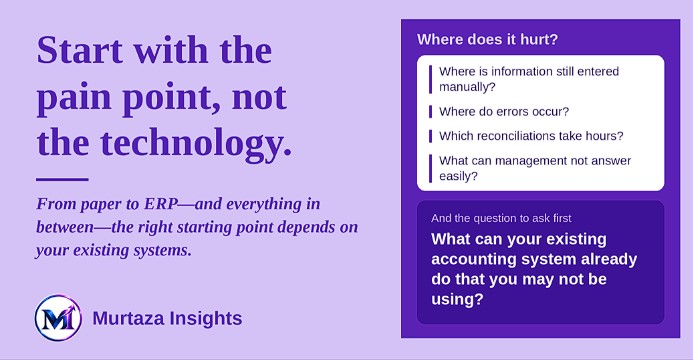
Where AI can help a finance function depends on how it operates today. Identify which documents are re-entered, which reconciliations take hours and which management questions the existing reports cannot answer.
Check what your accounting software can already do. Where a gap remains, use the six environments below to identify where AI or conventional automation could help.
Start with exceptions you can verify against source records, such as unmatched invoices, unreconciled balances and unexplained differences.
At a Glance
| Current environment | Main opportunity for AI | Possible outcome |
|---|---|---|
| Paper/manual | Digitise and check | Searchable, usable information |
| Manual + Excel | Automate and analyse | Less compilation, more analysis |
| Legacy accounting | Improve processes around the ledger | Better answers without automatically replacing a working system |
| Modern cloud accounting | Use built-in capabilities first | More value from software already purchased |
| Accounting + specialist systems | Reconcile and analyse across systems | A broader commercial view |
| Full ERP | Interpret, prioritise and interrogate | Faster management insight |
- Current environment
- Paper/manual
- Main opportunity for AI
- Digitise and check
- Possible outcome
- Searchable, usable information
- Current environment
- Manual + Excel
- Main opportunity for AI
- Automate and analyse
- Possible outcome
- Less compilation, more analysis
- Current environment
- Legacy accounting
- Main opportunity for AI
- Improve processes around the ledger
- Possible outcome
- Better answers without automatically replacing a working system
- Current environment
- Modern cloud accounting
- Main opportunity for AI
- Use built-in capabilities first
- Possible outcome
- More value from software already purchased
- Current environment
- Accounting + specialist systems
- Main opportunity for AI
- Reconcile and analyse across systems
- Possible outcome
- A broader commercial view
- Current environment
- Full ERP
- Main opportunity for AI
- Interpret, prioritise and interrogate
- Possible outcome
- Faster management insight
Some of these opportunities may be addressed through existing software or conventional automation without introducing AI.
Management usually receives reports designed in advance. AI may let an authorised manager ask a question nobody built into a standard report, so “please prepare another report” becomes “explain what is happening.” That still depends on reliable data, controls and structured financial reporting.
1. Mostly paper and manual records
For some businesses, the largest opportunity is also the most basic: getting useful information off paper.
Supplier invoices, LPOs, goods-received notes, receipts and payment approvals may still pass physically between employees.
The problems are familiar:
- information is entered more than once;
- documents go missing;
- input errors occur;
- approvals are difficult to track;
- discrepancies are discovered late;
- finding an old transaction can consume considerable time.
AI-supported document processing can read scanned documents, extract the data and compare an invoice with a local purchase order (LPO) and goods-received note (GRN), flagging missing documents, price or quantity differences and duplicates.
What could you ask?
- Which supplier invoices do not have supporting GRNs?
- Which invoices exceed their approved LPOs?
- Which transactions are waiting for approval?
- Have we received two invoices with the same number?
2. Manual processes supported by Excel
Excel remains useful. Problems arise when important processes depend on repeated copying and pasting, multiple versions of worksheets, complex formulas or the knowledge of one employee who understands how everything fits together.
Finance staff can spend more time preparing information than analysing it.
AI may assist with consolidation, reconciliation, classification, identifying missing or duplicate transactions and highlighting unusual movements.
KRA’s VAT return system uses electronic invoice records, and eligible input VAT claims generally depend on valid, transmitted TIMS/eTIMS invoices or other permitted supporting records. Missing or invalid records can delay, or in some cases prevent, VAT recovery.
KRA also validates income and expenses declared in income tax returns against eTIMS, withholding-tax and customs information, subject to applicable exceptions.
For these compliance checks, automated matching can flag purchase invoices with missing or mismatched eTIMS records before filing, giving the finance team time to investigate.
This would not replace professional tax judgement or statutory responsibility. It could reduce manual checking and identify exceptions earlier.
What could you ask?
- Why are expenses above budget this month?
- Which accounts remain unreconciled?
- Which transactions do not agree with our VAT or eTIMS records?
3. Basic or legacy accounting systems
An older accounting package is not necessarily a bad accounting package.
I experienced this personally with Pastel before it became part of Sage.
Pastel performed its accounting role satisfactorily. Around it we developed separate Excel/VBA applications for management information and controls, and used Excel and PowerPoint extensively for reporting.
Delays in transferring data between our server and remote locations were one of the main reasons we moved to ERP. We could not resolve them with the internet bandwidth available at the time. Our Excel/VBA applications also depended heavily on full-time in-house programmers, and we had concerns about their security.
AI would not have added bandwidth, and it would not have removed the need to maintain and secure the VBA applications.
We eventually moved to Oracle ERP — a major implementation involving considerable time, cost, process redesign, testing, training and management involvement.
With today’s technology, I would ask an additional question before assuming that a dependable accounting core needed replacing:
Which problems really require a new accounting system, and which could be solved around the existing one?
A company using an older version of QuickBooks, Pastel/Sage or another reliable package can use AI to:
- check information before accounting entry;
- compare LPOs, GRNs and supplier invoices;
- reconcile accounting and stock records;
- identify unusual transactions;
- analyse exported ledger data;
- improve cash, margin and working-capital analysis.
What could you ask?
- Which customers are progressively slowing payment?
- Which items have not moved for six months?
- Which products are accumulating stock while sales decline?
- Why did gross margin fall: was it selling price, purchasing cost, volume or product mix?
4. Modern cloud accounting
Businesses using modern cloud accounting should start with a different question:
What can the system already do?
Current accounting products increasingly contain automation and AI of their own.
Xero’s Just Ask Xero (JAX) and QuickBooks’ Intuit Intelligence are examples. The capabilities available depend on the product, subscription, market and user permissions.
Before buying another application, check whether the current licence includes features that could replace manual routines or unnecessary Excel exports.
Only after that should management identify the gaps — perhaps deeper analysis, forecasting, combining operational and accounting information, or providing more flexible management enquiry.
What could you ask?
- What are the three most important financial changes this month?
- What happens to cash if collections slow by ten days?
5. Accounting software plus specialist systems
This environment may be particularly familiar to established manufacturing, processing, FMCG, distribution and trading businesses.
Accounting sits in one system and inventory in another, with separate applications for payroll, purchasing, sales, production, warehousing or CRM and Excel filling some gaps. Each may work adequately. The difficulty is between them.
Finance repeatedly exports information and reconciles different sources. Product codes may not match. Month-end relies on several departments supplying information.
Management can see accounting, stock and sales separately, but it is harder to understand how they interact.
AI can help compare datasets, identify mismatches and analyse financial and operational information together.
What could you ask?
- Sales increased — why didn’t cash?
- Which high-revenue customers produce poor margins?
- Which stock shortages appear to have affected sales?
- Is overtime increasing without a corresponding rise in production?
- Where do warehouse quantities disagree with accounting stock?
6. Full ERP
With ERP, the work shifts from bringing records together to deciding what needs investigation. A typical ERP integrates finance, purchasing, sales, stock and operational information.
Even with integrated data, managers may still export reports to Excel and rely on finance to investigate variances. Operational alerts can also outnumber what managers have time to review.
AI can help users query ERP data, prioritise exceptions and investigate their causes.
What could you ask?
- Why did operating profit fall despite higher sales?
- Which suppliers are becoming less reliable?
- Which branches or departments require attention?
- Which operational exceptions are financially significant today?
AI may also surface exceptions or trends management hasn’t noticed, answering “what should I be looking at that I haven’t asked about?”
What AI cannot fix, and the controls it needs
Financial statements, reconciliations, control reports and regular management information will remain essential.
AI cannot analyse information that the business has never captured properly.
If stock movements are missing, documents are incomplete, accounting entries are wrong or controls are routinely bypassed, AI may help expose the weaknesses.
It cannot simply manufacture an accurate history.
Human review also remains essential for payments, accounting adjustments, tax treatment, policy decisions and material business decisions.
Before introducing AI tools, management should also establish what information may be shared externally, particularly supplier banking details, payroll and customer information.
There is an important distinction between a tool that proposes an accounting entry for approval and one authorised to post it automatically. Access controls, segregation of duties and audit trails must remain effective. Automation should not weaken accountability.
Start with the business problem
Asking complex business questions in natural language could be valuable, but its usefulness depends on the quality, completeness and accessibility of the underlying information.
Before approving an investment, management should establish whether the proposed improvement:
- reduces processing time, errors or repetitive work;
- strengthens controls, information quality or decision-making;
- delivers benefits that justify implementation costs, recurring charges and staff training.
Choose the change that addresses the problem:
- use a feature already available in the accounting system;
- change an inefficient process;
- eliminate unnecessary manual work;
- introduce a focused AI tool;
- connect information from separate systems;
- or replace an inadequate system.
Whichever option you choose, test it on a problem you can measure, such as the time spent clearing unmatched invoices or the number of discrepancies still open at month-end.
Could Your Business Get More from Its Information Systems?
An independent review of information systems and business processes can help management identify inefficiencies, improve information flows and assess opportunities to make better use of existing technology. The focus is on improving business operations and management decisions, rather than providing accounting or tax services.
The starting question is: “Which information or process problem is most limiting your business decisions today?”
Related: Don’t Invent It. Technify It.
Sources & References
- Kenya Revenue Authority — VAT Auto-Populated Return FAQs. Conditions for claiming input VAT and reconciling electronic invoices.
- Kenya Revenue Authority — Validation of Income and Expenses in Income Tax Returns. Public notice covering validation effective 1 January 2026.
- Xero — Just Ask Xero (JAX), official product overview. Official product guidance.
- QuickBooks — Introducing Intuit Intelligence. Official product capabilities and availability information.
© 2026 Murtaza Insights
More from Information Systems & Process Improvement
Information Systems & Process Improvement · Last updated: 11 November 2026
Don’t Invent It. Technify It.
Many new technology ideas begin with old business practices. Explore how AI and software can remove their limitations and create practical opportunities for your business.
Read ArticleMore Insights
Business Performance Reviews · Published: 11 November 2026
Your Sales Grew. But Did Your Business Actually Improve?
What Tesco, Sainsbury's and two Kenyan companies reveal about measuring genuine business improvement—and turning annual reviews into effective action plans.
Read Article
Business Analysis & Strategy · Last updated: 13 November 2026
Should Your Budget Be Based on Your Ambitious Sales Target?
Keep ambitious sales targets without automatically committing the spending needed to achieve them.
Read Article